
How to Make a Persuasive Case for a Master Key System

A persuasive request connects a master key system to a workplace problem your boss already needs to solve. If you’re deciding how to convince your boss that your workplace needs one, describe the access challenges, explain how the system could address them, and present a practical plan for implementation. Keep the focus on organizational needs, budget considerations, and the work involved.
It’s reasonable for a manager to weigh a security change against competing priorities and the team’s workload. Make that decision easier by showing how the current approach causes friction, outlining the potential benefits, and explaining how the organization could assess the result. Connect your request to company goals, present it as a proposal rather than a demand, and prepare to discuss cost, rollout, and responsibilities. Once the idea is approved for review, a commercial locksmith can help assess workplace locks and access needs.
Table of Contents
1. Explaining benefits to the employee and organization
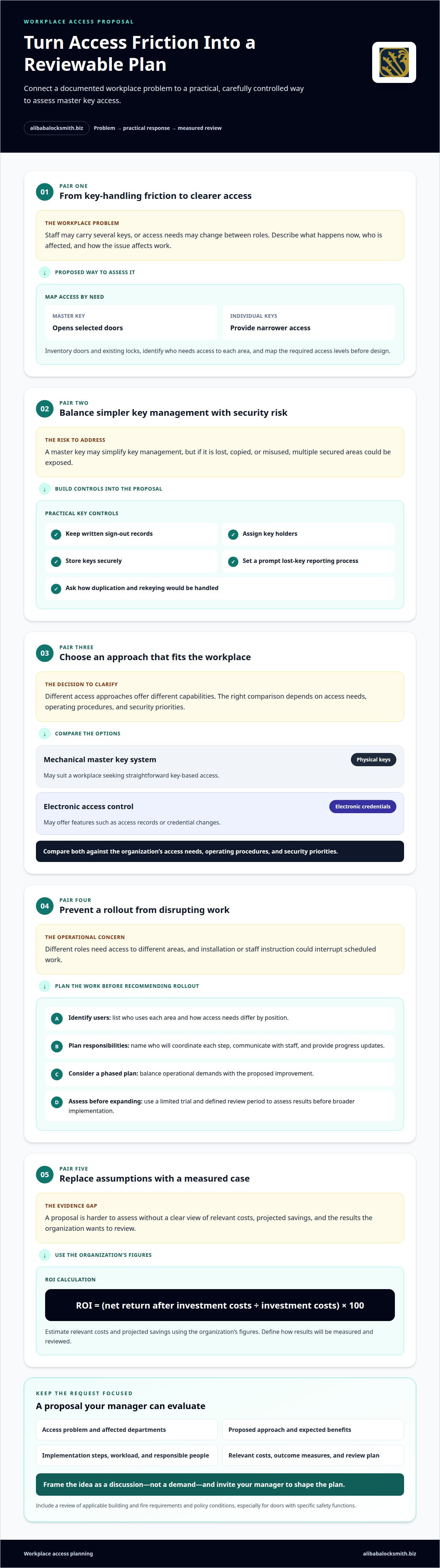
Start with a documented workplace problem, such as staff carrying several keys or access needs changing between roles. Explain what happens now, who is affected, and how a master key system could address the issue. A clear rationale helps your manager assess the change across the organization, not just its effect on your own routine.
A master key system can let an authorized key open selected doors while individual keys provide narrower access. This may simplify key management, but the master key needs careful control. If it is lost, copied, or misused, multiple secured areas could be exposed, so address that risk alongside the potential benefit.
A mechanical master key system uses physical keys rather than electronic credentials. Electronic access control may offer features such as access records or credential changes, while a mechanical system may suit workplaces seeking straightforward key-based access. Compare the options against the organization’s access needs, operating procedures, and security priorities.
For a Denver workplace, don’t assume one rule applies to every building, fire-safety condition, or insurance policy. Include a review of applicable building and fire requirements and policy conditions in the proposal, especially for doors with specific safety functions.
Propose an audit before design: inventory doors and existing locks, identify who needs access to each area, and map the required access levels. Ask a locksmith how the proposed hierarchy could work, which locks may need attention, and how future changes or rekeying would be handled.
Also ask how to report lost keys, control duplication, and handle rekeying. Written sign-out records, assigned key holders, secure storage, and prompt reporting give the organization practical ways to reduce loss and unauthorized copying.
Show the implementation steps, responsible people, timeline, and a way to measure results. Estimate relevant costs and projected savings using the organization’s figures; calculate ROI by dividing net return after investment costs by investment costs, then multiplying by 100. A limited trial and defined review period can help assess results before broader implementation.
Frame the work as an opportunity to develop project-planning and security-management skills. Taking responsibility for coordination, staff communication, and progress updates demonstrates professional growth while showing how improved access management could support company operations.
2. Aligning a request with company and team priorities
To convince your boss, connect the request to a current department priority, not simply a preference for carrying fewer keys. If staff regularly need access to several work areas, for example, explain how a defined access plan could support daily operations. Name the affected roles and show how the proposed change fits the organization’s security and workflow goals.
Show how the change could affect the team before recommending a rollout. Identify who uses each area, how access needs differ by position, and whether installation or staff instruction could interrupt scheduled work. A phased plan may help managers balance operational demands with the proposed improvement. Include who would coordinate each step and how you would keep the department informed.
Graduate-degree demand is not evidence that a master key system is needed. Historical projections about graduate credentials, including projections for job openings and management positions by 2020, address education and hiring, not workplace access. Don’t use them to prove an access-control case. Instead, tie your request to specific operational priorities, such as reducing key-handling friction for employees with different access needs.
Submit a written request for approval so your manager can review the proposal and share it with relevant decision-makers. Keep it focused: state the access problem, affected departments, proposed approach, expected benefits, implementation steps, and the decision you’re requesting. Include the team’s workload and the roles responsible for planning, communication, and follow-through.
Make the request formal but concise. Use a clear subject line, such as “Proposal to review workplace key access,” then organize the message into short sections or paragraphs. Ask for a meeting to discuss priorities and invite feedback on the scope. This gives your boss room to shape the plan rather than respond to a demand.
Once the organization is ready to assess the physical access needs, commercial locksmith services can help inform the next step.
3. Communicating desires rather than demands
Present the master key system as a proposal for discussion, not an instruction your manager must follow. Instead of saying, “We need to change the locks,” try, “I’d like to explore whether a master key system could address the access issues in our department.” This makes your interest clear while leaving room for your boss to weigh options.
Support your reasoning with a specific workplace example. You might describe how staff with different responsibilities access shared rooms. Then explain what you hope would improve, such as making access easier to manage without giving every employee the same level of access. Keep the example factual and work-focused.
A private planning note might read, “I’m trying to understand how to convince my boss we need a master key system without making this sound like a demand.” Use that thought to clarify your purpose, then present the request calmly and professionally. Aim for a constructive conversation, not pressure for an immediate yes.
Make a clear, limited request. Ask your manager to discuss whether the idea fits current priorities rather than demanding approval for a full installation. This gives your boss a practical decision to consider and a chance to raise concerns you may have missed. It also recognizes their responsibility for budget and operations.
Use “I” statements to describe what you’ve observed and what you’d like to accomplish. For example: “I’ve noticed that access responsibilities differ across roles, and I’d like to explore a clearer system.” Avoid blaming coworkers or making broad claims you can’t support.
Listen closely to your boss’s response. If they raise concerns about disruption, ask which part worries them, then adjust your proposal. You could say, “Would reviewing the affected doors be a useful first step?” This keeps the conversation focused on practical next steps.
Close by asking for guidance. A useful planning note might read, “I’m considering how to convince my boss we need a master key system, and I want to invite feedback.” Ask whether your manager prefers a written summary or a follow-up discussion with relevant team members.
4. Making a persuasive case for employer support
A persuasive case depends on a clear need and your credibility as an employee. Follow through on existing responsibilities before proposing a new initiative: meet agreed deadlines, communicate issues early, and bring a specific example of an access problem you observed. This helps your manager assess the proposal as a considered workplace improvement.
Connect the request to a recognizable organizational change. If workload has increased while processes have stayed the same, for example, explain how those processes affect access and daily work. Don’t assume a master key system will solve every operational challenge. Describe the specific access issue it could address and identify concerns that still need review.
Ask your boss for feedback before treating the proposal as final. Invite them to identify operational concerns, affected teams, or information they need to make a decision. Incorporate their suggestions and show what changed. This makes the discussion collaborative and gives your manager a clear opportunity to shape the plan.
Prepare for practical questions with a concise implementation outline. Identify who would coordinate the work, how staff would learn about access changes, and how progress would be communicated. If your manager is concerned about disruption, explain how the schedule could account for team responsibilities. Tie each response to the workplace issue rather than unsupported security claims.
End the discussion with a specific next step, such as asking permission to develop a fuller proposal. Bring a brief summary of the problem, intended outcome, and unresolved decisions. If the proposal is approved, share a schedule and keep your boss informed about progress, efficiencies, and challenges. Following through demonstrates ownership and helps leaders assess results against the original need.
Strong performance and a record of keeping commitments establish credibility. Asking your boss for feedback and incorporating suggestions strengthens the plan. Consistently exceeding expectations can help a team member gain a senior leader's attention and receptivity to their ideas.
Ali Baba Locksmith
Ali Baba Locksmith provides commercial locksmith services for workplace lock and access needs in the Denver metro area. Once your employer is ready to explore a master key system, a professional assessment can help focus the discussion on the building’s doors, existing locks, and staff access requirements. This is a practical next step when the organization has agreed to assess its current setup or needs guidance on commercial lock options.
Share the workplace access concerns and the goals your team identified. That context helps make the conversation specific to your organization’s needs. Ali Baba Locksmith also provides residential, automotive, and emergency locksmith services, but commercial locksmith services are the relevant offering for a workplace access question.
Contact Ali Baba Locksmith to discuss your commercial locksmith needs.
Turn the Proposal Into a Practical Next Step
Turn the discussion into a decision your manager can act on. If you’re deciding how to convince your boss your workplace needs a master key system, clarify the open questions, agree on who should weigh in, and define what approval would allow you to do next. A focused follow-up keeps the idea moving without treating approval as a foregone conclusion.
Once your employer is ready to explore the workplace’s lock needs, Ali Baba Locksmith offers commercial locksmith services. The company also provides residential and automotive locksmith services. Bringing in professional support can help connect your workplace’s access goals to practical locksmith work.
Take the next step when your organization is ready to discuss its commercial access needs. Contact Ali Baba Locksmith for help, and move the conversation forward with confidence.
Frequently Asked Questions
How much does it cost to install a commercial master key system?
The cost of a commercial master key system depends on the project. Factors include the number of doors, the condition and type of existing locks, the building layout, and how access needs differ across roles. For a Denver workplace, reviewing these details helps define the project’s scope before requesting a quote.
Are there local building codes, fire codes, or insurance requirements for commercial master key systems?
Requirements may vary by building, fire-safety conditions, and insurance policy. Include a review of applicable building and fire requirements and policy conditions in the proposal.



Comments